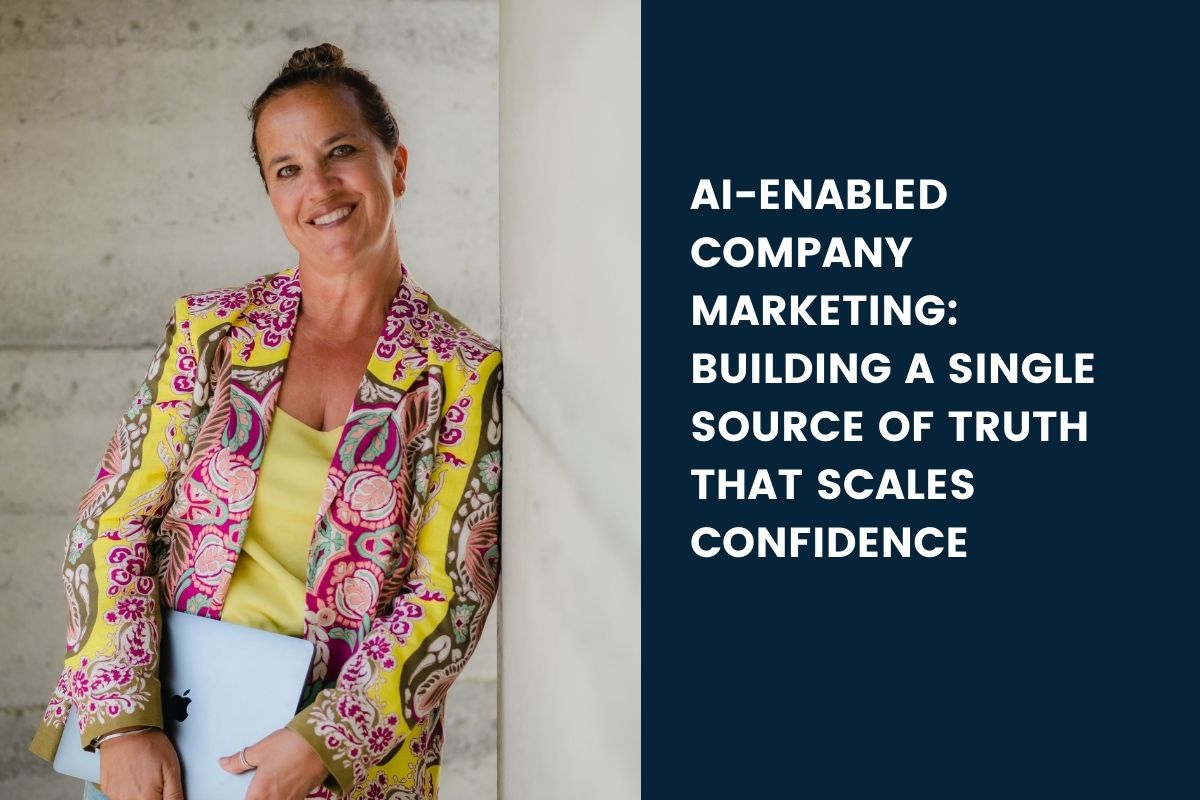
The changing face of marketing leadership
Marketing has shifted from a functional discipline to a leadership one.
As a Fractional Marketing Manager working across multiple organisations, and as an early adopter of AI technology, I’ve had a front-row seat to how quickly expectations have changed. Leaders are no longer looking for more campaigns or more tools. They are looking for clarity, consistency, and confidence that marketing activity genuinely reflects who they are as an organisation.
AI has accelerated this shift. It has made speed and scale accessible, but it has also exposed where strategy, brand understanding and human insight are weak or fragmented. In organisations where foundations are strong, AI becomes a genuine advantage. Where they are not, AI simply magnifies the gaps.
The most effective use of AI in marketing today is not about replacing human judgement. It is about protecting it, while leaning into the strengths AI offers — speed, pattern recognition and capacity — in a way that still feels human, deliberate and on-brand.
This balance between human insight and AI precision is where modern marketing leadership now sits.
A three-part series on optimising marketing and AI
This article is the first in a three-part series exploring how organisations can optimise marketing and AI in a way that is structured, secure and genuinely effective.
Across the series, we will explore:
- Foundations – building the AI Brain and Emotional Empathy Profile that anchor brand, tone and audience understanding
- Governance and structure – ensuring AI use is brand-safe, secure and aligned without slowing teams down
- Automation and workflow – using AI to increase capacity and consistency once the foundations are in place
This first article focuses on the essential starting point.
Before tools, automation or efficiency gains, organisations need a shared intelligence layer — often referred to as an AI Brain — underpinned by a clear Emotional Empathy Profile. Together, these define how the organisation thinks, speaks and connects with its audiences.
Without this foundation, AI-enabled company marketing struggles to scale with confidence. With it, AI becomes a strategic asset rather than a risk.
Why AI exposes weakness in marketing foundations
AI does not create confusion. It reveals it.
In many organisations, marketing knowledge is fragmented:
- brand guidelines exist, but are inconsistently applied
- tone shifts depending on who is creating content
- audience understanding lives in individuals rather than shared systems
- strategy and execution are poorly connected
When AI tools draw from this environment, the output feels uneven or generic. Not because the technology is flawed, but because the organisation has never aligned on a single, shared reference point.
In AI-enabled company marketing, this misalignment becomes visible faster than traditional workflows ever allowed.
What a single source of truth really means
A single source of truth is not a document, a prompt library or a platform.
It is an agreed marketing intelligence layer that sits underneath all activity — human or AI-generated — and defines:
- how the organisation describes itself
- how it wants to sound and be perceived
- who its audiences are and what matters to them
- what must remain consistent, and where flexibility is intentional
At Infokus, this forms the foundation of our AI Marketing Framework, designed to build brand clarity, capacity and strategic structure before AI usage is scaled.
In AI-enabled company marketing, this foundation allows teams to move faster without losing coherence, because the guardrails already exist.
Governance without slowing teams down
One of the most common concerns raised by senior leaders is loss of control.
AI feels fast, decentralised and difficult to govern.
In practice, control issues emerge when foundations are weak. When a single source of truth exists, governance becomes lighter, not heavier.
Within the Infokus AI Marketing Framework, governance is embedded upstream. This means:
- clearer boundaries around brand and tone
- reduced reliance on approval cycles
- fewer rewrites and corrections
- greater confidence in delegation
AI-enabled company marketing works best when control is designed into the system, not enforced after the fact.
Why this is also a leadership and culture issue
Although AI conversations often sit with marketing teams, the implications are broader.
A single source of truth reflects how aligned an organisation really is. Where internal understanding of brand, purpose and audience is weak, AI output simply mirrors that weakness at scale.
This is why Heads of People & Culture and senior leaders are increasingly involved. AI-enabled company marketing intersects with:
- shared language and cultural alignment
- confidence in decision-making
- clarity around delegation and accountability
Strong foundations support better marketing outcomes — and stronger leadership behaviour.
Scale without losing confidence
AI promises scale. What many organisations fear is dilution.
A single source of truth resolves that tension. It allows marketing teams to increase volume, speed and experimentation without eroding trust or brand integrity.
In AI-enabled company marketing, this is the point where organisations move from experimentation to confidence. AI stops feeling risky and starts feeling useful.
About the contributor
Tanya Duncan is the Director of Infokus Marketing & AI Agency, a strategic marketing partner helping businesses grow with clarity, confidence and momentum.
Infokus blends strategic marketing leadership, human insight and AI precision, supporting organisations through:
- clear marketing strategy and direction
- hands-on execution and prioritisation
- Fractional Marketing Manager leadership
- brand-trained AI systems that scale safely
Tanya has worked with Galvin-Rowley Executive to embed AI as a strategic capability, aligned with brand, voice and governance expectations.
Continue the conversation
If AI is already part of your marketing stack — but confidence, consistency or control are not where they need to be — a conversation about foundations is often the right place to start.
You can connect directly with Tanya Duncan for a practical discussion about AI-enabled company marketing and the Infokus AI Marketing Framework.
0418 557 323
tanya@infokus.com.au | www.infokus.ai | www.infokus.com.au